
Train Travel in Canada
Travelling by train is a comfortable and scenic way to discover Canada. At Viaraildeals.ca, we help travellers explore available VIA Rail Canada promotions, special offers, and seasonal discounts to find fares that suit their travel plans and budget. Whether you are looking for weekly promotional fares, partner offers, or limited-time deals, there may be several opportunities to save on your next train journey. Explore this guide to learn about current and recurring discount options, understand eligibility requirements, and discover practical ways to find better-value VIA Rail tickets.
Train travel in Canada offers a comfortable, memorable way to explore the country’s vibrant cities, historic communities, beautiful coastlines, and spectacular natural landscapes. From short journeys between major cities to multi-day trips across the country, travelling by train lets you enjoy the scenery while someone else does the driving.
Whether you are planning a business trip, a weekend getaway, a family holiday, or a cross-country adventure, Canadian rail services offer options to suit a range of itineraries and budgets. VIA Rail Canada operates passenger train services across several regions, connecting destinations in Ontario, Québec, the Atlantic provinces and Western Canada.
Travellers can explore VIA Rail ticket deals, fare options, popular routes, and practical booking tips. Planning ahead, comparing available departures and understanding ticket conditions can help you choose a journey that fits your schedule and budget.
This guide explains how train travel in Canada works, which routes to consider, what to expect onboard, and how to find available ticket promotions before booking.
Why Choose Train Travel in Canada?
Travelling by train offers a different experience from driving or flying. Instead of focusing on the road or navigating airport procedures, passengers can settle into their seats, enjoy changing landscapes, and make the journey part of the holiday.
Enjoy Scenic Canadian Landscapes
Canada’s size and geographical diversity make rail travel particularly appealing. Depending on your route, you may see waterfront communities, farmland, forests, rivers, mountain scenery and remote northern landscapes.
Some long-distance journeys are attractions in their own right. The Canadian, for example, connects Toronto and Vancouver, crosses several provinces, and offers views of Canada’s varied terrain. The Ocean connects Montréal and Halifax, providing an alternative way to travel between Central and Atlantic Canada.
Scenery varies by route, season, weather and daylight hours. Consider your departure time and the length of your journey if particular views are an important part of your travel plans.
Travel Between Major Cities
Passenger trains connect many important Canadian destinations, making rail travel useful for holidays, family visits, and business trips.
Popular city pairs include:
- Toronto and Montréal
- Toronto and Ottawa
- Montréal and Québec City
- Ottawa and Montréal
- Windsor and Toronto
- Montréal and Halifax
- Toronto and Vancouver
Services and journey times vary by route. Some corridors have multiple departures on many days, while long-distance services may operate on a more limited schedule.
Enjoy a More Relaxed Journey
On many services, passengers can read, work, listen to music, enjoy refreshments or simply watch the scenery. Depending on the train and fare class, onboard amenities may include reclining seats, power outlets, Wi-Fi, food services and additional space.
Amenities are not identical across all routes or train types. Check the facilities available on your specific departure before choosing a ticket.
Reduce the Stress of Driving
Rail travel can be useful when you would rather avoid long-distance driving, traffic congestion, parking costs, and planning a road route. Travellers can also use train journeys to connect with accommodation, local transport and sightseeing activities at their destination.
However, trains do not serve every community in Canada. Check departure and arrival stations, onward transport options, and total door-to-door journey time before you plan.
Popular Train Routes in Canada
VIA Rail offers several routes for short city breaks and longer Canadian holidays. The best option depends on where you are starting, how much time you have and whether you prefer a direct journey or a scenic trip with connections.
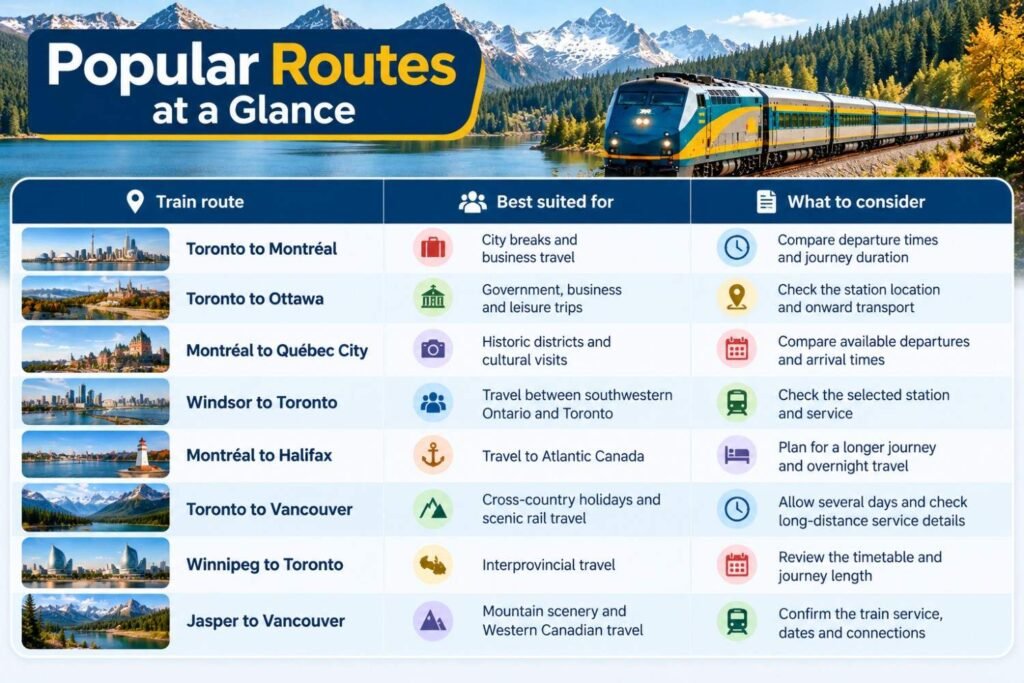
Popular Routes at a Glance
| Train route | Best suited for | What to consider |
|---|---|---|
| Toronto to Montréal | City breaks and business travel | Compare departure times and journey duration |
| Toronto to Ottawa | Government, business and leisure trips | Check the station location and onward transport |
| Montréal to Québec City | Historic districts and cultural visits | Compare available departures and arrival times |
| Windsor to Toronto | Travel between southwestern Ontario and Toronto | Check the selected station and service |
| Montréal to Halifax | Travel to Atlantic Canada | Plan for a longer journey and overnight travel |
| Toronto to Vancouver | Cross-country holidays and scenic rail travel | Allow several days and check long-distance service details |
| Winnipeg to Toronto | Interprovincial travel | Review the timetable and journey length |
| Jasper to Vancouver | Mountain scenery and Western Canadian travel | Confirm the train service, dates and connections |
These are examples of established rail corridors and destinations, not a guarantee that every route operates daily or offers a direct train. Confirm the itinerary for your intended travel date before booking.
Toronto to Montréal Train
The Toronto–Montréal route is a popular choice for travellers visiting Canada’s largest city and Québec’s largest city. It suits weekend trips, business appointments, and visits with friends or family.
Before booking, compare departure times, journey duration, fare conditions and station access. If you are travelling to a meeting or connecting with another service, leave enough time for possible delays and onward travel.
Montréal to Québec City Train
A train journey between Montréal and Québec City is a practical option for exploring Québec’s cultural attractions, historic neighbourhoods and dining destinations.
Travellers can compare available departures to find a suitable arrival time. If you plan to explore Québec City on arrival, consider how far your accommodation is from the station and whether you will need a taxi, public transit or another local transport option.
Toronto to Vancouver Train
The Canadian offers a long-distance rail journey between Toronto and Vancouver. This route appeals to travellers who want to experience the scale and variety of the Canadian landscape rather than simply reach their destination as quickly as possible.
A cross-country train trip requires more planning than a short corridor journey. Consider the total travel time, accommodation arrangements, meal options, luggage requirements and the possibility of schedule changes. Sleeper accommodations may be available on applicable services, subject to the route, date and booking conditions.
Montréal to Halifax Train
The Ocean connects Montréal and Halifax and provides a rail option for travellers heading to Atlantic Canada.
Because this is a long-distance journey, review the timetable carefully and check the accommodation and meal arrangements associated with your selected fare. If you are travelling to another Atlantic destination, you may also need to arrange a connecting bus, taxi or other transport.
Understanding VIA Rail Ticket Classes
Choosing the right fare class can influence your comfort, onboard experience and overall travel budget. Availability depends on the route, train, travel date and booking conditions.
Economy Class
Economy is a common choice for travellers looking for a practical way to reach their destination.
Features may include:
- Standard passenger seating
- Access to available onboard facilities
- Food and beverage services on applicable trains
- The opportunity to compare different fare levels where offered
Economy is often worth considering for shorter journeys or travellers who prefer to spend less on the ticket. However, the cheapest available fare may have stricter change or cancellation conditions.
Business Class
Business Class is available on certain routes and may provide additional comfort and service compared with Economy.
Depending on the service, features may include more spacious seating, meal service and other amenities. Business Class is not offered on every VIA Rail train, so confirm availability for your route.
It may suit business travellers or passengers who value the added onboard services. Compare the fare difference with the benefits included before deciding whether an upgrade is worthwhile.
Sleeper Plus Class
Sleeper Plus accommodations are offered on applicable long-distance services and are designed for overnight travel. Depending on the train and accommodation selected, passengers may have access to sleeping arrangements and services that are different from standard daytime seating.
Review the accommodation type, meals, washroom arrangements and included services carefully. Availability and features can vary by route and train.
Prestige Class
Prestige Class is a premium accommodation option on applicable long-distance services. It is designed for travellers seeking a more private and upgraded experience.
Availability is limited, and prices can differ considerably from standard seating. If you are considering Prestige Class, compare the included amenities and total fare with other available accommodation categories.
Comparing Ticket Options
| Ticket class | General purpose | Important consideration |
|---|---|---|
| Economy | Practical, budget-conscious travel | Compare fare rules and included services |
| Business | An upgraded experience on eligible routes | Confirm availability and specific benefits |
| Sleeper Plus | Overnight and long-distance travel | Check accommodation type and inclusions |
| Prestige | Premium long-distance accommodation on eligible services | Review availability, fare and included amenities |
The class names and features shown here are a general guide. Always check the details displayed for the specific train and fare you intend to purchase.
How to Find VIA Rail Ticket Deals
Train ticket costs can depend on several factors, including travel dates, demand, route, class, and the fare category you select. Comparing available options is one of the most useful steps you can take when planning a trip.
Book in Advance Where Possible
Booking ahead gives you more time to compare departures and available fare categories. Some services offer fewer low-priced options, so waiting until the last minute can limit your choices.
Advance booking does not guarantee the lowest fare. Check the available prices for your dates and review the conditions attached to each option.
Compare Different Departure Times
If your plans are flexible, compare more than one departure. Travelling at a different time or on another eligible date may provide a better fare or a more convenient itinerary.
When comparing prices, look at the full journey, not just the ticket price. An arrival time that requires an additional hotel night or expensive onward transport may not offer the best overall value.
Look for Current Promotions
VIA Rail may offer promotions or special fares under specific conditions. Offers can vary by route, travel period, passenger eligibility and booking deadline.
Before using a promotion, check:
- The dates when the offer can be booked
- The eligible travel dates
- The routes and fare classes included
- Whether a promotional code is required
- Any passenger eligibility requirements
- Restrictions on changes, cancellations or refunds
Do not assume that a promotion applies to every departure. Confirm the terms before completing your booking.
Check Eligibility-Based Discounts
Some offers may be intended for specific passenger groups or travel purposes. Eligibility requirements can vary, and proof of eligibility may be required.
Read the offer conditions carefully to confirm who qualifies and whether the discount applies to your chosen itinerary. Avoid relying on a discount until it appears in the fare details or is confirmed through the applicable booking channel.
Compare the Total Cost
A lower headline fare is not always the best choice for every traveller. Review the total cost and the conditions before paying.
Consider the following:
- Ticket price for all passengers
- Applicable taxes and fees
- Baggage allowances and any additional charges
- Seat or accommodation options
- Change and cancellation conditions
- The cost of transport to and from each station
Comparing these details can help you make a more informed decision.
VIA Rail Ticket Deals With viarailbooking.ca
At viarailbooking.ca, we help travellers explore VIA Rail ticket information, available promotions and booking considerations for journeys across Canada. Whether you are planning a short trip between cities or a longer rail holiday, understanding your options can make the booking process easier.
Our goal is to help you identify relevant ticket opportunities, understand fare conditions and make a more informed choice before travelling.
Get Help Exploring Ticket Options
If you need assistance finding information about VIA Rail ticket deals, you can contact our team to discuss your planned journey.
Call for VIA Rail ticket deals: +1 (888) 988-6792
When enquiring, it helps to have the following details ready:
- Departure city and destination
- Preferred travel date
- Approximate departure time
- Number of passengers
- Preferred travel class
- Any flexibility in your travel dates
These details make it easier to discuss options relevant to your trip.
Promotional availability, fare amounts and booking conditions can change. Confirm the final price, applicable terms and booking arrangements before purchasing. Viaraildeals.ca is an independent travel-deals website and is not the official VIA Rail Canada website.
How to Book a Train Journey in Canada
Booking a train journey is straightforward when you know your route and travel requirements. The steps below can help you prepare before selecting a fare.
Step 1: Choose Your Departure and Arrival Stations
Start by identifying the stations that best suit your itinerary. Some cities have multiple stations or transport connections, so confirm the exact departure and arrival locations.
If your destination is outside the rail network, investigate connecting transport before booking.
Step 2: Select Your Travel Dates
Enter your preferred departure date and, if applicable, your return date. If your schedule is flexible, compare nearby dates to see whether different departures or fares are available.
Step 3: Compare Available Trains
Review the available departures and compare journey times, arrival times and connection requirements. For long-distance trips, check whether the service operates on your selected date.
Do not rely on a timetable from another travel date as confirmation of your own train’s schedule.
Step 4: Choose Your Fare and Class
Review the available fare categories and accommodation options. Check the conditions for changes, cancellations and refunds before selecting a ticket.
If you are using a promotional offer, verify that your chosen journey qualifies and that the discount is reflected in the final price.
Step 5: Review Passenger and Baggage Details
Enter passenger information accurately and check the baggage allowance for your specific train. Rules can differ between services, so confirm permitted baggage sizes, quantities and any restrictions.
Step 6: Confirm Your Booking
Before payment, review the itinerary, passenger details, total cost, travel dates and ticket conditions. Keep your booking confirmation accessible and check for updates before departure.
What to Know Before Travelling by Train in Canada
A little preparation can make a rail journey more comfortable, especially when travelling with children, carrying luggage or taking a long-distance service.
Arrive at the Station Early
Allow enough time to find the correct station entrance, locate your platform or boarding area and complete any required boarding procedures. The recommended arrival time may vary by station and service, so follow the instructions provided with your booking.
Understand Your Baggage Allowance
Baggage rules depend on the train, route and fare conditions. Some services permit checked baggage, while others may have different arrangements.
Before departure:
- Check the current carry-on baggage allowance.
- Confirm whether checked baggage is available on your route.
- Review size and weight limits.
- Label your bags with your contact information.
- Keep essential medication, travel documents and valuables with you.
- Check restrictions on prohibited or restricted items.
Do not assume that baggage policies are identical across all Canadian train services.
Bring Essentials for Longer Journeys
For a long journey, consider carrying a reusable water bottle (where permitted), snacks (if appropriate), headphones, a book, a phone charger, and any personal items you may need.
On overnight trips, check whether meals, bedding and other amenities are included in your selected accommodation. Bring any additional items that will make the journey more comfortable.
Plan for Connections
If you need to connect to a bus, flight or another train, leave a reasonable buffer between services. Operational conditions, weather, and other factors can affect long-distance journeys.
For important onward connections, consider the consequences of a delay and check the applicable policies for each part of your itinerary.
Check Accessibility Requirements
Travellers who require mobility assistance or other accessibility arrangements should review the services available at their departure and arrival stations and onboard their selected train.
Contact the relevant service provider in advance if you need assistance with boarding, mobility devices, seating or other arrangements. Availability and procedures may differ by station and route.
Train Travel in Canada by Season
Canada’s weather varies considerably by region, and seasonal conditions can affect both the travel experience and the preparation required.
Spring Train Travel
Spring can be a good time for city visits and shoulder-season holidays. Temperatures and weather conditions vary across the country, so pack layers and check the forecast for your destination.
If your trip includes outdoor activities, confirm that attractions and local transport services are operating on your travel dates.
Summer Train Travel
Summer is a popular period for holidays, family visits and sightseeing. If you plan to travel during a busy period, compare fares early and check accommodation availability at your destination.
For scenic journeys, consider how daylight hours and the timing of your train affect the views you hope to enjoy.
Autumn Train Travel
Autumn offers opportunities to see changing foliage across much of Canada. Routes through forested regions can be particularly appealing during the fall colour season, although peak colours vary by location and year.
Book accommodation and onward activities with enough flexibility to account for changing conditions.
Winter Train Travel
Winter journeys can offer distinctive views of snow-covered landscapes, but cold weather may affect local transport and travel arrangements.
Check service updates before departure, dress appropriately for the weather and allow extra time to reach the station. Review cancellation and change conditions if your plans depend on connecting transport or weather-sensitive activities.
Planning a Budget-Friendly Canadian Rail Holiday
A successful rail holiday involves more than finding an inexpensive ticket. Accommodation, food, local transport and activities all contribute to the overall cost.
Create a Realistic Travel Budget
Before booking, estimate the main expenses associated with your journey.
| Expense | What to consider |
|---|---|
| Train tickets | Fare class, passenger count and return travel |
| Accommodation | Hotel location, number of nights and seasonal prices |
| Meals | Onboard options and meals at your destination |
| Local transport | Public transit, taxis, rideshares or transfers |
| Attractions | Admission fees, tours and activities |
| Extra expenses | Baggage costs, travel essentials and contingency funds |
Choose an Itinerary That Fits Your Time
A short city-to-city journey may suit a weekend break, while a cross-country train trip can require several days. Avoid planning too many activities around a tight arrival schedule.
For multi-stop holidays, compare the cost and convenience of visiting destinations in a logical order. Check which connections are available and whether you need an overnight stay between services.
Balance Price and Convenience
The lowest ticket price may involve an inconvenient departure time, a longer journey or stricter fare conditions. A slightly more expensive option may suit your plans better.
Compare the full itinerary, including station access and onward travel, before deciding which ticket offers the best value for your circumstances.
