VIA Rail Seating Map 2026: Seat Layouts, Seat Selection & Coach
Planning a train journey across Canada involves more than choosing a departure time and purchasing a ticket. Your seat, travel class, available legroom, window access, and onboard facilities can all influence your experience.
The VIA Rail seating map helps passengers understand the seating arrangements and accommodation options available on different trains. However, there is no single seating plan that applies to every VIA Rail service. A Corridor train travelling between Toronto and Montréal has a different interior arrangement from a long-distance train operating between Toronto and Vancouver.
VIA Rail offers several travel experiences, including Economy, Business, Sleeper Plus, and Prestige Class on selected routes. Depending on your journey, you may have access to standard reclining seats, preferred seating, private cabins, or upper and lower berths.
This guide explains the different VIA Rail seating arrangements in 2026, how to select or change an assigned seat, what to know about long-distance accommodation, and how to choose a suitable option before booking.
Understanding the VIA Rail Seating Map
A train seating map is a visual representation of the passenger seating arrangement inside a train car. It can help travellers understand where seats are located and, where seat selection is available, choose an appropriate position.
A seating plan may show:
- Individual seat numbers
- Rows and seat positions
- Aisle locations
- Window-side seats
- Single and paired seating arrangements
- Accessible seating areas
- Washrooms and other onboard facilities
- Sleeping accommodation on selected long-distance trains
The exact information displayed depends on the train and reservation system. Some VIA Rail services provide assigned seat selection, while long-distance services may offer accommodation choices rather than a conventional numbered-seat map.
Why the Seating Layout Matters
Reviewing the available seating information before travelling can help you:
- Understand where your assigned seat is located.
- Check whether a window or aisle position is available.
- Choose a preferred seat when the booking system permits it.
- Coordinate seating with other passengers.
- Identify accessible travel arrangements.
- Understand the difference between a standard seat and sleeping accommodation.
- Prepare for the facilities available in your selected class.
Travellers should always rely on the seat or accommodation information shown for their specific train and departure date rather than assuming that every train has the same interior.
VIA Rail Seating Options by Travel Class
VIA Rail offers different seating and accommodation experiences depending on the route.
| Travel Class | Seating or Accommodation | Typical Journey Type |
|---|---|---|
| Economy Class | Standard reclining passenger seats | Corridor and long-distance journeys |
| Business Class | Wider seats and upgraded seating experience | Selected Québec City–Windsor Corridor trains |
| Sleeper Plus Class | Upper and lower berths, private cabins and other sleeping arrangements | Selected overnight and long-distance trains |
| Prestige Class | Private premium cabin with upgraded seating and sleeping facilities | The Canadian, Toronto–Vancouver |
Availability depends on the route and train. Not every class is offered on every service.

Economy Class Seating Map
Economy Class is the standard seating option for travellers who want a comfortable train journey without paying for premium accommodation.
On Corridor services, Economy passengers travel in conventional passenger seats. The precise arrangement, seat numbering, and available selection options depend on the train.
Economy Class may be suitable for:
- Short and medium-distance journeys.
- Travellers looking for a standard fare.
- Students and young travellers.
- Families travelling between Canadian cities.
- Passengers who do not require overnight accommodation.
Economy Seating Features
Economy seating is designed for regular passenger travel and generally includes:
- Reclining or adjustable seating, depending on the train.
- Access to an aisle.
- Window-side seating where available.
- Overhead or other designated storage areas.
- Access to onboard washrooms.
- Electrical outlets on applicable services.
Some Economy fares include standard seat selection, while other fare types may have different selection conditions or fees.
Economy Window and Aisle Seats
Travellers who prefer looking at the scenery may wish to select a window seat when available. An aisle seat can be more convenient for passengers who expect to get up during the journey.
However, the exact position of a seat and its proximity to windows, doors, or other facilities can vary by train configuration. Check the seat-selection display when booking rather than relying on a generic diagram.
Business Class Seating Map
Business Class is available on selected services in the Québec City–Windsor Corridor.
It offers an upgraded travel experience with wider seats and additional onboard services. The seating arrangement may differ from Economy, and passengers can have access to preferred seating options.
Business Class may be suitable for:
- Business travellers.
- Passengers who want additional seating comfort.
- Travellers seeking a more premium daytime journey.
- Passengers who value onboard meal and lounge services.
Business Class Seat Features
Depending on the train and fare, Business Class may include:
- Wider passenger seats.
- Additional personal space.
- Preferred seating options.
- Access to a power outlet.
- Wi-Fi on applicable Corridor services.
- Meal and beverage service.
- Priority boarding.
- Access to selected Business lounges.
A single seat in Business Class may be attractive to someone travelling alone who prefers not to share a row with another passenger. Check the available seat-selection screen for the actual arrangement on your departure.
Sleeper Plus Class Accommodation Layout
Sleeper Plus Class is designed for selected long-distance and overnight journeys. Unlike a conventional seating map, its accommodation layout may include sleeping spaces and private cabins.
Depending on the train and route, options may include:
- Upper berths.
- Lower berths.
- Cabins for one.
- Cabins for two.
- Larger sleeping accommodation on selected services.
The precise accommodation types and facilities depend on the train.
Upper Berth
An upper berth is a raised sleeping space used for overnight travel on selected long-distance trains.
It is generally a compact accommodation option for passengers who want a place to sleep during the journey.
Before choosing an upper berth, consider:
- Access to the sleeping space.
- The available room around the berth.
- Storage requirements.
- Whether you are comfortable using an elevated sleeping arrangement.
- Any mobility or accessibility needs.
Lower Berth
A lower berth provides a sleeping space at a lower level than an upper berth.
It may be more convenient for passengers who prefer not to climb to an elevated sleeping area. Availability and the exact arrangement depend on the train.
Travellers should review the accommodation details before booking, especially when travelling with children or passengers who need additional assistance.
Sleeper Plus Private Cabins
Private cabins provide an enclosed accommodation space on selected long-distance services. Depending on the route and cabin type, the facilities may include seating during the day and sleeping arrangements at night.
Some cabins have access to shared washroom and shower facilities, while accommodation features differ by train.
Sleeper Plus passengers should check the specific route information to understand which cabin types are available and what services are included.
Prestige Class Seating and Cabin Layout
Prestige Class is a premium accommodation option available on The Canadian, which operates between Toronto and Vancouver.
Rather than a standard row-based seating arrangement, Prestige Class provides a private cabin designed for daytime relaxation and overnight sleeping.
The cabin generally includes:
- Modular seating.
- A large viewing window.
- A Murphy bed for two.
- A private washroom with shower.
- Storage facilities.
- Additional onboard services.
Prestige Class is intended for passengers seeking a premium long-distance experience. It is important to check the current route information and fare conditions because availability is limited to selected services.
VIA Rail Seating Map by Train Route
The seating and accommodation arrangements vary across VIA Rail’s different train services.
| Train or Route | Main Travel Classes | Seating or Accommodation |
|---|---|---|
| Québec City–Windsor Corridor | Economy and Business | Standard passenger seats and upgraded seating |
| The Canadian: Toronto–Vancouver | Economy, Sleeper Plus and Prestige | Reclining seats, berths and private cabins |
| The Ocean: Montréal–Halifax | Economy and Sleeper Plus | Reclining seats and selected sleeping accommodation |
| Winnipeg–Churchill | Economy and Sleeper Plus | Passenger seats and sleeping accommodation on applicable services |
| Other Adventure Routes | Economy and selected Sleeper Plus services | Seating and accommodation depend on the route |
Québec City–Windsor Corridor
The Corridor connects major cities in Ontario and Québec. Routes include Toronto–Montréal, Toronto–Ottawa, Ottawa–Montréal, and other city pairs.
Passengers generally choose between Economy and Business Class on applicable trains.
For these services, seat selection may be available through the booking system. Your assigned car and seat number are shown on your boarding pass after booking.
The Canadian: Toronto to Vancouver
The Canadian is VIA Rail’s long-distance service connecting Toronto and Vancouver.
The journey offers several travel experiences:
- Economy Class reclining seats.
- Sleeper Plus berths and private cabins.
- Prestige Class private accommodation.
Passengers can also enjoy common spaces such as the Skyline car and, on the Toronto–Vancouver service, the Park car. Access and included services depend on the class and applicable onboard rules.
The Canadian is a multi-day journey, so passengers should consider whether a standard seat or sleeping accommodation is more suitable for their travel plans.
The Ocean: Montréal to Halifax
The Ocean connects Montréal with Halifax and offers Economy and Sleeper Plus options.
Economy passengers travel in reclining seats, while Sleeper Plus passengers may be able to reserve sleeping accommodation, including selected private cabins.
The train also offers shared onboard spaces. Facilities and services can vary, so check the route details before selecting a fare.
How to Select Your VIA Rail Seat
Seat selection is available on applicable VIA Rail services. The process and available choices depend on the route and fare.
Step 1: Search for Your Train
Enter your departure station, destination, travel date, and passenger details in the official VIA Rail booking system.
Select an available departure to continue.
Step 2: Choose Your Travel Class and Fare
Review the available classes and fare categories.
For a Corridor journey, you may see Economy or Business Class options. For a long-distance journey, you may see Economy, Sleeper Plus, or Prestige Class, depending on the route.
Step 3: Review Seat Selection Options
If seat selection is available, follow the instructions displayed during booking.
The system may show standard and preferred seating options, depending on your fare and class.
Step 4: Choose an Available Seat
Review the available seats and select one that suits your preferences.
Consider whether you would prefer:
- A window seat.
- An aisle seat.
- A single seat in Business Class, if available.
- Seating near travelling companions, where possible.
Step 5: Confirm Your Reservation
Review your journey information and complete payment.
After booking, check your confirmation email and boarding pass. Your assigned train car and seat number are indicated on the boarding pass for applicable Corridor reservations.
Can You Change Your VIA Rail Seat After Booking?
On applicable Québec City–Windsor Corridor services, passengers can view and change their assigned seats online through the seat-selection or booking-management options.
Whether a change is available depends on the fare, train, and remaining seat inventory.
Before changing a seat, consider:
- Whether the new seat is available.
- Whether a selection fee applies.
- Whether your fare includes preferred seating.
- How close the departure time is.
- Whether the change affects passengers travelling together.
Do not assume that changing your seat is always free. Review the fee information shown for your reservation.
VIA Rail Seat Selection Fees and Fare Conditions
Seat selection rules can differ by fare category.
The following is a general guide based on VIA Rail’s published fare information. Always confirm the current amount and conditions during booking.
| Fare or Class | Standard Seat Selection | Preferred Seat Selection |
|---|---|---|
| Escape Economy | May involve an additional fee | Not included |
| Economy | Generally included | Included under applicable conditions |
| Economy Plus | Generally included | Included under applicable conditions |
| Business | Standard selection included | Additional fee may apply |
| Business Plus | Included | Included |
VIA Rail’s published optional-service information lists fees for certain seat-selection choices. Fees and conditions may change, so the booking screen should be treated as the final reference for your reservation.
Tips for Choosing the Best VIA Rail Seat
The best seat depends on your route, travel duration, personal preferences, and the available layout.
Choose a Window Seat for Scenic Views
A window seat can be a good choice for travellers who want to enjoy the scenery.
This can be particularly appealing on long-distance routes where the train passes through forests, mountains, lakes, and open landscapes.
However, not every seat provides the same view. Window alignment and visibility can vary by train car.
Choose an Aisle Seat for Easier Movement
An aisle seat may be more convenient if you expect to move around during the journey.
It can also be useful for passengers who prefer not to climb over another person when leaving their seat.
Consider Seating Together
Families and groups may prefer seats close to one another.
If you are travelling with other passengers, make your selections during the booking process when possible. Adjacent seats are subject to availability, and a group booking does not necessarily guarantee a particular seating arrangement.
Review Accessibility Requirements
Passengers who require accessible seating or additional assistance should review VIA Rail’s accessibility information before booking.
It is helpful to identify any mobility requirements early so the appropriate arrangements can be discussed with VIA Rail.
Consider the Journey Duration
For a short Corridor journey, a standard seat may be sufficient.
For an overnight or multi-day journey, consider whether sleeping accommodation would make the trip more comfortable. Compare the cost and facilities of available options before making a decision.
VIA Rail Seating for Families and Groups
Travelling with family members or friends can require additional planning.
When booking multiple passengers, consider the following:
- Enter each passenger’s information accurately.
- Check the seating options available for the whole group.
- Review child and infant travel conditions.
- Consider accessibility and mobility requirements.
- Confirm whether the selected accommodation is suitable for the number of passengers.
- Check baggage allowances for the selected fare.
Sleeper Plus and Prestige cabins have specific occupancy limits. Always check the permitted number of passengers for the accommodation you intend to book.
VIA Rail Seating for Passengers with Accessibility Needs
VIA Rail provides accessibility-related travel information and assistance options. However, the facilities available can vary by station, train, and route.
Passengers who require accessible seating, boarding assistance, mobility-device accommodation, or other support should contact VIA Rail before travelling.
When planning an accessible journey, consider:
- The accessibility of the departure and arrival stations.
- Boarding and alighting assistance.
- Available seating and accommodation arrangements.
- Space for mobility equipment.
- Washroom accessibility.
- Any assistance that should be arranged in advance.
Do not rely on a general seating diagram to confirm accessibility. Ask VIA Rail to verify the arrangements for your exact train and travel date.
Where to Find the Official VIA Rail Seating Map
The most reliable way to check seating information is through VIA Rail’s official booking and travel-information resources.
Use the seat-selection feature for applicable Corridor journeys to view or change an assigned seat. For long-distance trains, review the class and accommodation information for the specific route.
Useful official resources include:
- Seat selection: https://www.viarail.ca/en/plan/onboard-train/seat-assignment
- Classes and services: https://www.viarail.ca/en/travel-infos/classes-and-services
- Discover VIA Rail trains: https://www.viarail.ca/en/plan/our-trains
- Fare comparison: https://www.viarail.ca/en/plan/fare-comparison
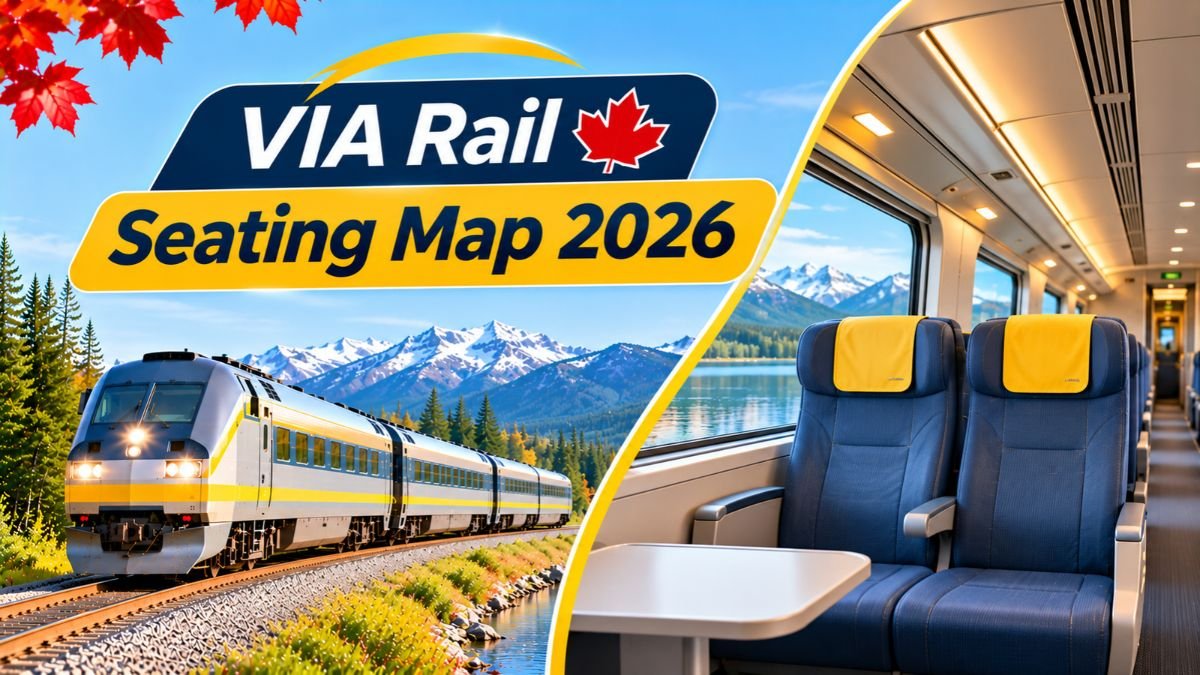
A general seating illustration may help explain the types of seats available, but it should not be treated as the exact layout of your assigned train.